

This post is based on my free online textbook (in progress): An Owner’s Guide to the Human Genome.
I’m reminded of a game in which the quizmaster asks seemingly impossible questions, like: “How many french fries are consumed per day in the US?”. The goal is to use logical reasoning to get to a sensible order-of-magnitude answer. For example, you might guess how often an average person eats french fries, and how many they would eat in a typical serving, and then note that there are about 330 million people in the US, to work your way to a reasoned answer.
These types of logic are also very helpful for thinking about genetics and genomics, but rarely taught. I often find that students are good at explaining complex molecular mechanisms, yet most have a hard time thinking about quantitative scales. For example, I might ask
“What is the average number of genes within a 1 megabase deletion?”, or
“How many single nucleotide differences are there between me and my mum?”, or
“What is the probability that a newborn child carries a de novo (i.e., new) protein-coding premature stop mutation?”, or
Could you give ballpark estimates without using a computer?
These skills are now more important than ever, in this new era of vibe-coding. Let’s say Claude Code confidently gives you some answer. How would you know if its answer is even in the right ballpark?
These problems are known as Fermi Problems after the 20th Century physicist and nuclear pioneer Enrico Fermi, who taught at the University of Chicago. One of his most famous challenges was to estimate the number of piano tuners employed in the city of Chicago. (You could get there by estimating how many households there are in Chicago, how many pianos there are, how often they need to be tuned, and how many pianos each tuner can do per week.)
To make progress with these questions in genomics, you do need to know Some Very Useful Numbers. Here’s a list to get you started, but you can skip over any that you don’t understand:
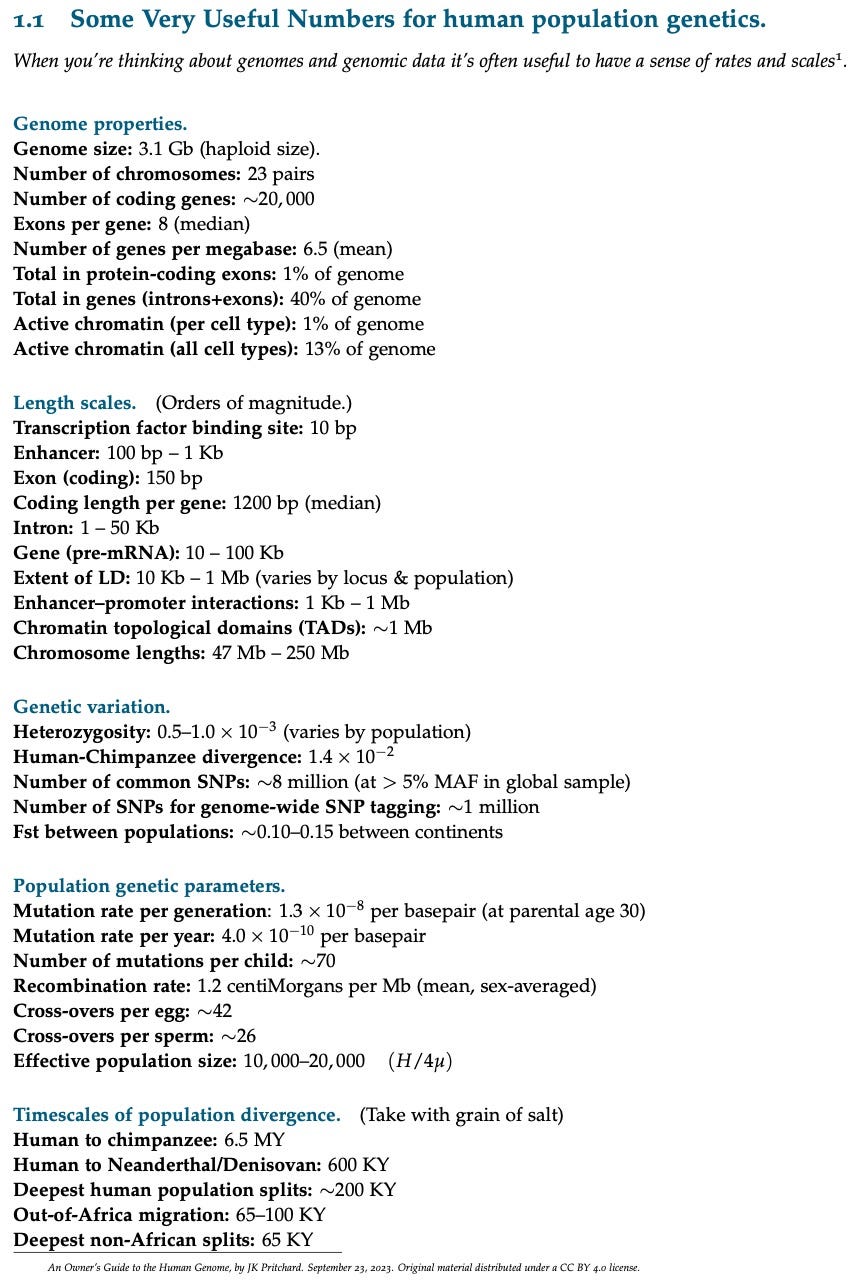
Let’s tackle those Fermi Problems in turn:
“What is the average number of genes within a 1 megabase deletion?”
For this one, you need to look up above to see that the genome contains ~20,000 protein coding genes, and it’s about 3 Gb (3 billion bases) long. And, by definition a megabase (Mb) is one million bases. So the number of genes per megabase is (20,000 genes/3 Gb) x (1 GB/1000 Mb) = 6.66 genes / Mb. So, around 7 genes per megabase deletion.
“How many single nucleotide differences are there between me and my mum?”
We’d notice that you share one copy of your 3 Gb genome with your mum, but the other comes from your dad. Heterozygosity measures the frequency of single nucleotide differences between two copies of a genome. In most human populations that’s around 0.8 x10⁻³. Multiplying that by 3 Gb tells us that you have (0.8x10-3) x (3x109) = 2.4 million differences from your mum.
That may seem like a lot, but if it makes you feel any better, you’ve got about 40 million differences from a chimpanzee.
“What is the probability that a newborn child carries a de novo (i.e., new) protein-coding premature stop mutation?”
Here, we’d start by noticing that there are about 70 new mutations per child. We then need to figure out the probability that one of these causes a premature stop mutation. About 1% of the genome is contained in coding exons. Next, if you think about the genetic code, 3 out of 64 possible mutations cause premature stops, and we can roughly double that to account for short insertion/deletion mutations, most of which cause frameshifts. Now we get to:
(70 mutations)*(1 coding mutation /100 mutations)*(2*3/64 stop mutations/coding mutation) = ~0.07 premature stops per child, or equivalently that about one child in 14 carries a premature stop.
[Since some stop mutations are incompatible with survival, the number at birth should be slightly lower, but that’s within the order-of-magnitude vibe here.]
If you want some practice, you can try these:
How many piano tuners are there in Chicago?
How many french fries are consumed per day in the US?
How many protein coding exons are there in the genome?
How much of the genome is contained in introns? What’s the average length of an intron?
What fraction of sites in the human genome are mutated, somewhere in the world, in each generation?
Most students may not be familiar with all these concepts — if you’re not, then you may enjoy learning more from my free online textbook!
And I’ll try to post more here from the textbook going forward.
Great to see someone teach the order-of-magnitude layer, it's the part that usually gets skipped between molecular detail and a final number.
The vibe-coding framing is the sharpest bit: the estimate's real job isn't the number, it's the tripwire that tells you a confident wrong answer is off by an order of magnitude. And the numbers you list are self-checking, the genes-per-megabase falls out of 20,000 over 3 Gb, so anyone can rebuild them rather than memorize them. That's the skill that survives whatever the model spits out.
Govi, not quite and this is an important distinction in how heterozygosity is defined. It is the average pairwise genetic divergence between two individuals (the mom and dad in this case). Heterozygosity is not the number of SNPs in the population, it's the average number of differences between two genomes, so this number intrinsically accounts for allele frequencies which is often not well understood by people. It doesn't measure how many things could be different, it measures how many things are different on average in pairwise comparisons.
And agree with the last two commentators, these measurements are mostly from inbred populations! So that heterozygosity measurement should be a good reflection of differences between two parents in the same population, but would we a heck of a lot different if one parent was from sub saharan Africa and the other wasn't.